

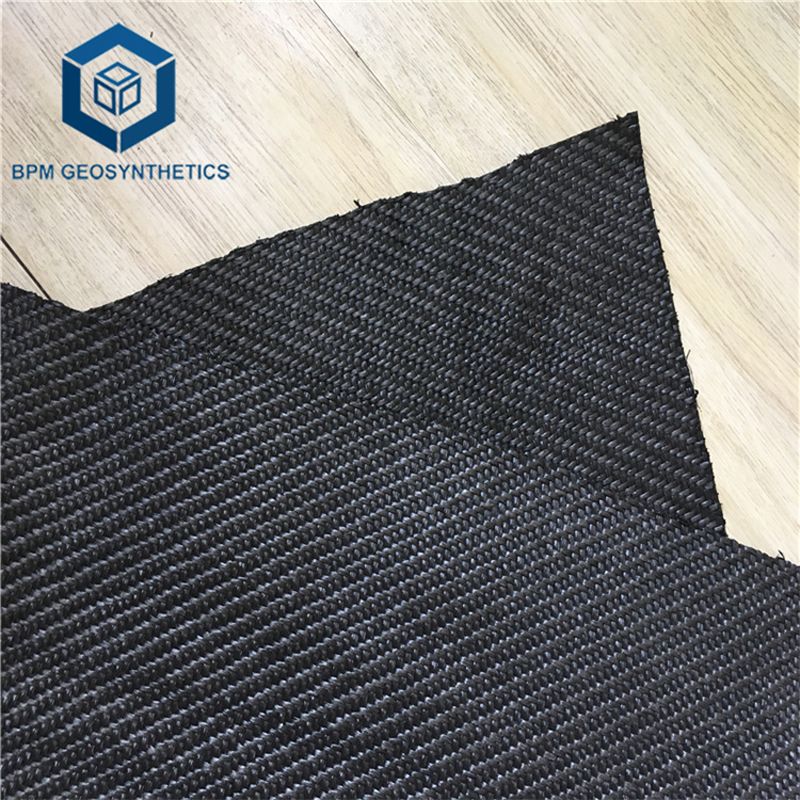
Woven geotextiles are a type of geotextile made from polypropylene or polyester fibers that are woven together to create a strong and durable fabric. They are designed to provide reinforcement and stabilization to soil, preventing erosion and improving the overall strength of the road. Woven geotextiles are commonly used in road construction, as well as in other civil engineerings projects such as retaining walls and embankments.
High strength
Woven geotextile has high tensile strength and tear resistance, and can effectively withstand the force of soil and water flow.
Corrosion Resistance
Woven geotextile has good acid resistance, alkali resistance, and corrosion resistance, and can be used stably for a long time under different soil and water quality conditions.
Water Permeability
Woven geotextile has good water permeability, allowing water to pass through and reducing water erosion and erosion of soil.
Breathability
Woven geotextiles have good air permeability and can maintain good soil ventilation, which is beneficial to plant growth and root development.
Anti-aging
Woven geotextile has anti-ultraviolet and anti-oxidation properties and can be used outdoors for a long time without damage.
Environmental Protection
Woven geotextiles are made of synthetic fiber materials, which will not cause pollution to the environment and meet environmental protection requirements.


Experienced team
The company has a team of experienced engineers and architects who work on various projects.
Competitive pricing
The company offers competitive pricing for their services and materials.
Customization
The company offers customization options for their products to meet customers'specific needs.
Strong customer service
The company has received positive reviews for its customer service and responsiveness to clients' needs.
Material of Woven Geotextile
Woven geotextiles are typically produced from woven and synthetic polymers. Polyester, polypropylene, polyamide and polyethylene polymers are mainly used in the manufacture of this fabric. Individual threads, such as polymers, fibrillated yarns, slit plies, and other materials, are woven into homogeneous sheets on a loom.
Application of Woven Geotextile
The woven geotextiles are created by weaving the yarn, therefore creating a strong fiber. This makes the woven geotextile ideal for strengthening soil and for reinforcement of structures such as walls, embankments, highways, under railroads, River, Canals, and Coastal Works, and as underlayment for house foundations.
Classification of Woven Geotextile

ynthetic filament woven geotextiles

Slit yarn woven geotextiles

Splitfilm yarn woven geotextiles

Plastic woven film yarn geotextile
Regularly clean and disinfect the surface of the woven geotextile to keep it clean and free of dirt Dyeing.
Avoid direct contact with sharp or high-temperature objects on the surface of the woven geotextile to prevent scratches two Or burned.
It is prohibited to store debris and heavy objects on or under woven geotextiles to avoid geotextiles. The fabric is deformed or damaged by compression.
Avoid walking or parking vehicles on or under woven geotextile to prevent woven geotextile damage, The fabric is wrinkled, deformed, or damaged by compression.
Regularly inspect and maintain woven geotextiles, promptly detect and handle damage to woven geotextiles, and Defects.
Strictly replace or update woven geotextiles according to their service life and renewal cycle, Ensure construction quality and safety.


Separation

Reinforcement

High Load Capacity

Referred To By Tensile Strength

Impermeable

Plastic-like
Determine the primary purpose of the woven geotextile. Whether it's for filtration, separation, reinforcement, drainage, or erosion control, ensure that the chosen geotextile aligns with the intended function to achieve optimal performance.
Evaluate the quality and durability of the woven geotextile material. Look for high-quality materials that are resistant to chemical degradation, UV exposure, and physical wear and tear. This will ensure a longer lifespan and better overall performance.
Look for environmentally friendly woven geotextile options. Consider their ecological footprint, recyclability, and potential effects on the surrounding environment.
Evaluating the cost-effectiveness of geotextiles. While it is important to consider the upfront costs, also evaluate the long-term benefits and potential savings associated with using high-quality geotextiles that require less maintenance or replacement over time.
Separation: For separation, a geotextile can be installed between two different soil materials. The geotextile will help to separate dissimilar materials so that the required soil characteristics can be obtained.
Filtration: For filtration, geotextiles are used to allow water to move in both directions in a drainage system and can be used to prevent fine aggregates from moving between soil layers.
Reinforcement: When a geotextile is introduced in the soil for soil improvement, its design is based on factors such as:
Friction or movement restraint
Support of loads
Changes in bearing failure plane
Sealing: A geotextile fabric can be filled with asphalt or other mixes to make it impermeable, thereby making it capable of stopping the flow of water in both directions.
Protection: For protection, geotextiles can be used to absorb stress and thus reduce or prevent damage and erosion in geotechnical structures.
While there are a few of the different geotextile fabric types available, the non-woven and woven ones are the most common. The two fabrics are distinct from one another in many ways. Some of the highlighting differences are:
A woven geotextile fabric has a high tensile strength and load capacity whereas a non-woven fabric is measured by its weight.
Non-woven geotextiles are mainly used for filtration, drainage and separation functions. On the contrary, woven geotextiles are an ideal choice for stabilization and reinforcement applications.
The flow through rate of non-woven fabrics are high but the woven fabrics have low flow through rate making them semi-permeable.

The use of geotextiles are commonly seen to improve soil over which embankments, roads, earth retaining structures and pipelines are built. Whether it is woven geotextile for roads or non-woven for drainage solutions, geotextiles can perform many critical functions. Some of them are :
When a particular area has two different soil materials, separating the two of them becomes essential to gain the most benefits. The installation of geotextile between two different soil materials helps in performing the function of separation.
In such circumstances, the geotextile will separate the two dissimilar materials so the needed soil properties can be obtained. The main purpose of using geotextile for separation is that when water seeps into the soil strata, the geotextile fabric effectively prevents soils from mixing.
There are a few critical factors based on which the geotextile is used for boosting soil characteristics. These are :
Support of loads
Movement or friction restraint
Bearing failure plane alterations
Geotextiles are used on roads and embankments that are developed over extremely poor grade soils, permitting steeper embankments. For applications as such, it is always suggested to develop and follow design parameters offered by an expert geotechnical engineer.
Geotextile fabrics are also used for the purpose of filtration. As the use of these fabrics allow water to move in both directions. Both non-woven and woven geotextiles can serve this purpose as they help in preventing fine aggregates from coming in between soil layers.
Based on the permeability and porosity of geotextile material it can also dissipate the kinetic energy formed by the capillary rise of groundwater and even promote lateral flow of water drainage.
Geotextile material is capable of impregnating with asphalt or other mixes to transform them into impermeable material. This helps in restricting the liquids flow in both directions.
This function can only be performed by using non-woven geotextile fabric. The sealing capacity of such fabrics is used for the prevention of soil contamination or to avoid pollutants affecting groundwater or to decrease potable water loss due to contamination or evaporation.
Geotextiles also provide the function of protecting the soil from erosion that can happen in embankments due to repeated drawdown or currents, etc. A layer of geotextile material installation can come handy in preventing fine material leaching.


Q: What is woven geotextile used for?
Q: Does water pass through woven geotextile?
Q: What is the difference between geogrid and woven geotextile?
Q: Should I use woven geotextile fabric under pavers?
Q: What do the numbers in the name of woven geotextiles mean?
Q: How are woven geotextiles made?
Q: Why is a woven geotextile fabric placed under the gravel pad?
Q: Which is better woven geotextile or nonwoven geotextile?
Q: Where can woven geotextiles be laid directly?
Q: How long does woven geotextile last?
Q: Will woven geotextile break?
Q: Can grass grow through geotextile fabric?
Q: Can you lay woven geotextile over gravel?
Q: Can you drive on woven geotextiles?
Q: What are the 3 main uses of a geotextile?
Q: How thick is woven geotextile?
Q: What does woven geotextile do?
Q: Where are the woven geotextiles?
Q: Is woven geotextile necessary?
Q: What are the different types of woven geotextiles?
We're known as one of the most professional woven geotextile manufacturers and suppliers in China. Please rest assured to buy high quality woven geotextile made in China here from our factory. For price consultation, contact us.
geotextile for construction, Polypropylene Woven Geotextile, geotextile for tunnels(0/10)

